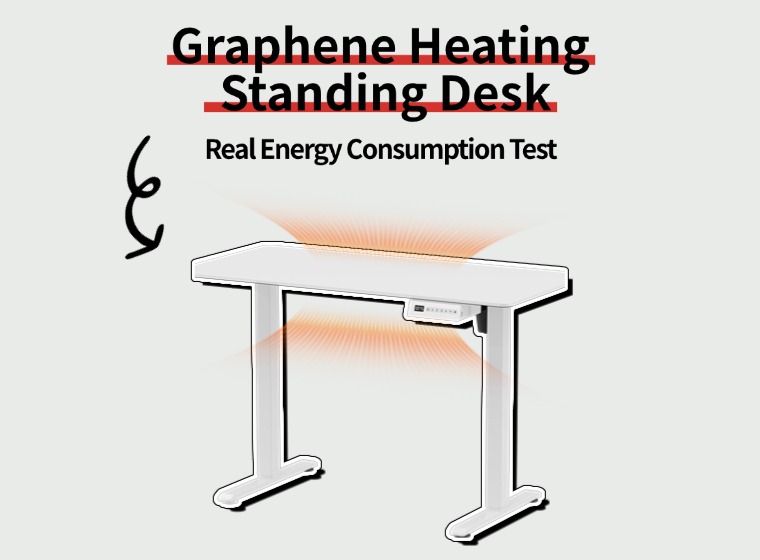
In autumn and winter, working at a desk or helping children with homework often means cold hands and feet, which can reduce both comfort and focus. Turning on the air conditioner heats the whole room but uses a lot of energy; using a conventional space heater takes up floor space and often delivers uneven warmth — usually warming only the feet while leaving the hands cold.
The Yuanxi Technology Graphene Heating Standing Desk heats the entire desktop evenly while also delivering warmth beneath the desk. This targeted heating helps keep both hands and feet comfortably warm.
However, many customers still wonder when choosing a model: Does the heating function consume a lot of electricity? Will it increase running costs?
To address these concerns, we carried out an energy consumption test under simulated real-world conditions, following a standardized testing process. The measured data below provides an objective answer to these power-usage questions.
1、Test Conditions
This test replicates a typical indoor usage environment, with direct sunlight, airflow, and external heat sources excluded to minimize interference. This ensures the results closely reflect real-world usage.
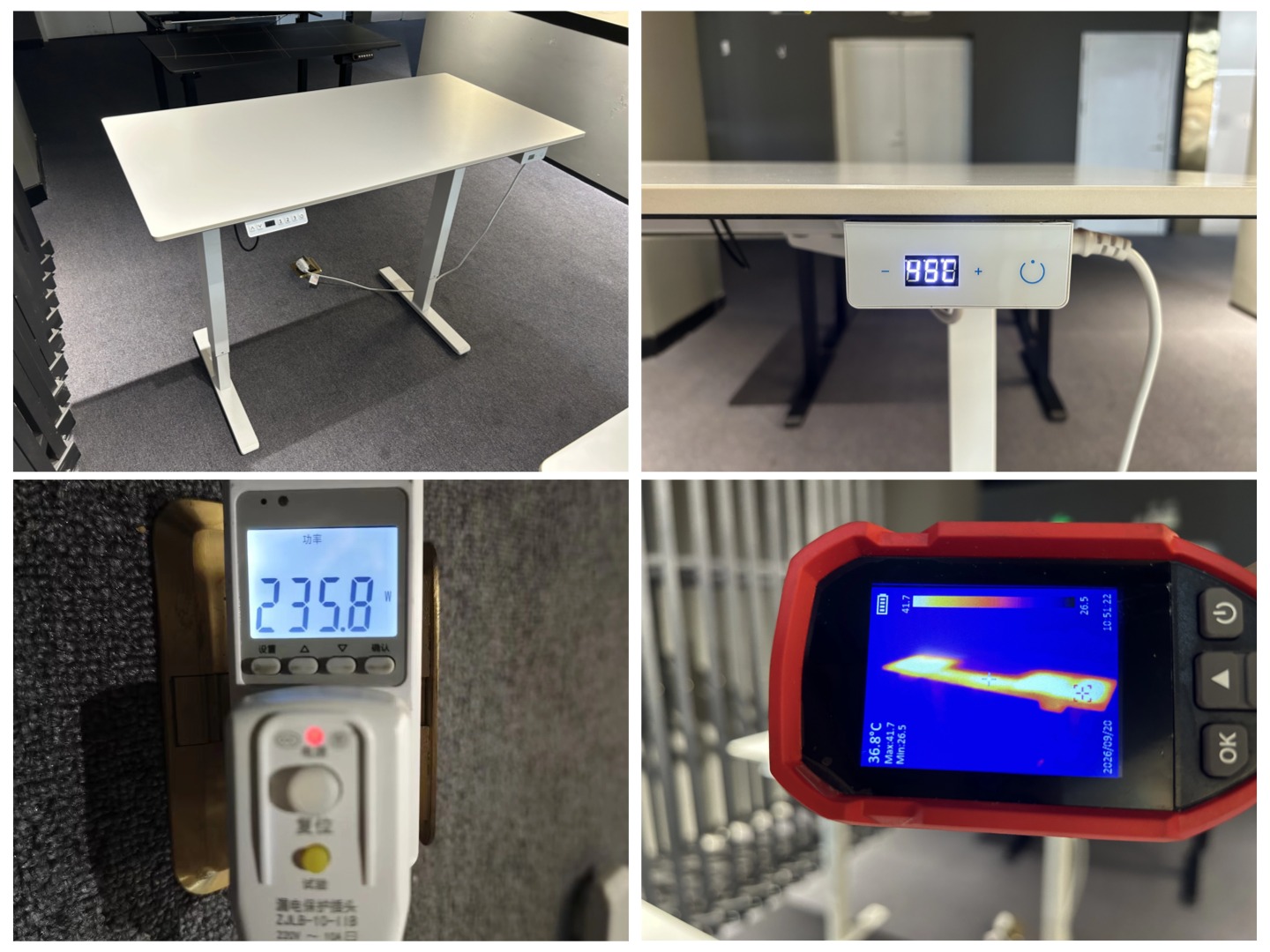
Product: Graphene Heating Standing Desk
Dimensions: 600 mm × 1200 mm
Rated Power: 235 W
Heating Area: Writing surface
Test Environment: Indoor ambient temperature of 26°C, with no strong airflow, direct sunlight, or additional heat sources.
Test Settings: Desktop temperature set to 45°C; the device was powered on continuously for 5 hours.
Test Equipment: A high-precision energy metering plug was used to monitor and record power consumption data throughout the test.
2、Measured Results
Conclusion First:
After 5 hours of continuous power-on testing, the desktop temperature remained stable at 45°C, with a total energy consumption of just 0.38 kWh.
To put that in perspective: running it for 12 hours straight would use less than 1 kWh of electricity.
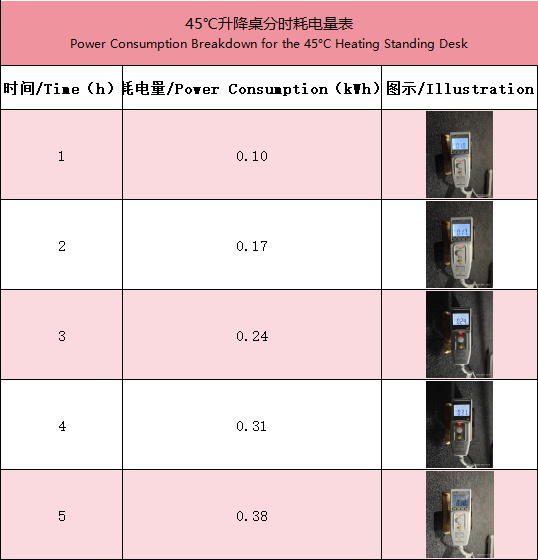
The data shows:
① First Hour | Warm-Up Phase
After powering on, the desktop quickly heats up to 45°C. This phase uses relatively more energy, but the actual power draw reaches only 43% of the rated 235W — it does not run at full power continuously.
② Remaining 4 Hours | Constant-Temperature Phase
Once 45°C is reached, the desk automatically reduces output, using power only to offset heat loss and maintain a stable temperature. This phase is more energy-efficient, with an average power draw of about 30% of the rated power. Based on the 235W rating, that equals roughly 0.07 kWh per hour.
Putting it in real cost terms:
Using a typical residential electricity rate of about ¥0.6 per kWh:
- 5 hours of continuous use: 0.38 kWh → about ¥0.23
- 12 hours of continuous use: under 1 kWh → under ¥0.60
- 12 hours a day, 30 days a month: only around ten-plus yuan in electricity — enough to keep the desktop comfortably warm for work or study.
Compared with heating an entire room using air conditioning, this heating standing desk focuses warmth only on the desk area. The heat is more concentrated and the warming is more targeted, giving it a clear advantage in energy efficiency.
3、Why It Uses So Little Energy
① Constant-Temperature Control with Automatic Power Reduction
Once the desktop reaches the set temperature of 45°C, the graphene heating desk does not keep running at full power. Instead, it automatically lowers its output and only uses enough energy to offset heat loss, keeping the temperature steady. During this constant-temperature phase, the average power draw is about 30% of the rated power.
② High Heat-Conversion Efficiency, with Heat Released as Far-Infrared Radiation
The graphene heating layer emits 4–16 μm far-infrared rays, which directly warm the user and the desktop through radiant heating. This reduces energy wasted on heating the surrounding air, delivering a warmer feel and higher overall heat utilization.
③ Uniform Surface Heating, with No Localized Overheating
The entire rock-slab desktop heats evenly, maintaining a stable surface temperature. This avoids the common issue of traditional linear heating elements, where localized high temperatures cause concentrated heat loss.
④ Low Thermal Inertia for More Precise Temperature Control
The graphene heating layer is extremely thin and has low heat capacity, so it heats up quickly and retains very little residual heat after being switched off. This prevents the desk from continuing to overheat due to stored heat, reducing unnecessary power consumption.
4、Feel Free to Contact Us
Powered by high-efficiency graphene heating technology and paired with an intelligent temperature control system, the product delivers precise, localized warmth. Compared with whole-room air-conditioning heating, it offers superior energy efficiency while maintaining a stable, comfortable desktop temperature.
The graphene heated standing desk series has passed multiple authoritative safety certifications, including China’s 3C, international CB, EU CE, US FCC, Japan PSE, and Korea KC — ensuring reliable quality and safety.
For more product details, please feel free to contact us.
Get in Touch
- Address: 9F, Building B4, No. 131 Jihua West Road, Chancheng District, Foshan City, Guangdong Province
- Website: http://www.yesusee.com
- Contact: Miss Zhang | +86 18825177897